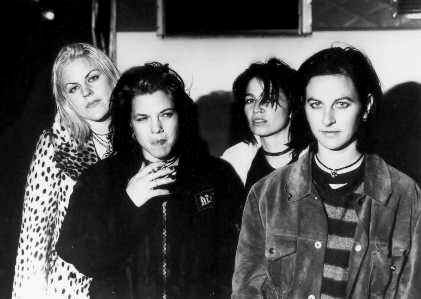
7 Year Bitch had to deal with more shit in a couple of years than most bands should have to deal with in a lifetime.
That's not where I want to start, though.
Because before all that, they were just a really good punk band.
They formed in Seattle in 1990, before everybody with a distorted guitar and a Washington driver's license was suddenly supposed to be part of the same movement. Selene Vigil sang, Stefanie Sargent played guitar, Elizabeth Davis played bass and Valerie Agnew played drums. There had been an earlier band called Barbie's Dream Car involving some of them, and Valerie had come into Seattle already connected with people around the Gits. That whole Rathouse crowd mattered. Bands rehearsed together, helped each other get records made, put together shows, and generally did the things people do when nobody important is waiting around to help them.
I wouldn't call 7 Year Bitch a grunge band except as a convenient record-store geography lesson. They were a punk band. They were four women in a punk band, which meant they got called an "all-girl band" approximately every fifteen seconds, and later they got swept into the riot grrrl story whether that fit perfectly or not. There was obviously common ground there. They were women playing loud, pissed-off music, some of the songs were explicitly feminist, they turned up on Kill Rock Stars, and "Dead Men Don't Rape" isn't exactly coy about where it's coming from. But Seattle wasn't Olympia, and 7 Year Bitch had their own thing going before anybody needed to give it a movement name.
Their first records sound like that too. There's a three-song 7" with "Lorna," "No Fuckin' War" and "You Smell Lonely" that came out through Face The Music and Rathouse in 1991 and got reissued by C/Z. There's a numbered Chow Down 10" picture disc on C/Z, and if you collect this stuff you already know how annoying it is to see one of those when you're broke and then spend the next three years not seeing another one. There were also a couple of British records, including the Antidisestablishmentarianism EP and a split with Thatcher On Acid. A lot of that material eventually wound up together on Sick 'Em.
Somebody put Sick 'Em on at the store not too long after it came out and that was my introduction.
"Chow Down." "Lorna." "You Smell Lonely." "No Fucking War." "Dead Men Don't Rape." "8-Ball Deluxe."
It wasn't pretty and it wasn't trying to be. Selene sounded like she was about two seconds away from climbing through the speakers and starting an argument with you personally. Valerie played drums like she was trying to put holes in them. Liz held the whole thing together underneath, and Stefanie's guitar had this nasty, scraping quality that made the songs sound even more unstable than they already were.
The strange thing about buying Sick 'Em in late 1992 was that Stefanie was already gone.
Stefanie Sargent died June 27, 1992. She was twenty-four. She had just gotten back from New York, where the band had played the New Music Seminar. The papers here reported it as an apparent heroin overdose. There was a syringe near her body. That's about as much detail as I feel like turning into rock trivia. Heroin was around this town, and pretending otherwise now would be bullshit, but Stefanie was a guitar player and a songwriter before she was a cautionary tale.
Sick 'Em sometimes gets treated like the album the band made after she died, which isn't really what it is. The recordings were made between 1990 and June 1992 at places including Avast! and Word of Mouth, and the record pulled together material from those earlier singles and EPs. Stefanie plays guitar on all of it. By the time C/Z put the album out that fall, it had become a posthumous record whether anybody had intended that or not.
For a while there wasn't even an obvious answer to whether 7 Year Bitch still existed.
They didn't just plug another guitarist into Stefanie's spot the following week and keep the machine running. They mourned her. They talked about whether they could continue. Ronnie Bopo, a friend of Stefanie's, filled in on guitar for some shows while they figured it out. Roisin Dunne, who had been living down in Los Angeles, eventually came back to Seattle and started rehearsing with them.
That little in-between period is when I first saw them.
November 20, 1992, at the Moore Theatre. Ten bucks, eight o'clock, a benefit for Seattle Rape Relief. Laughing Hyenas were on the bill along with 7 Year Bitch, My Diva, Maxi Badd and 66 Saints, with everybody getting something like half an hour. Ronnie was playing guitar with 7 Year Bitch that night. Roisin was already rehearsing with them, but hadn't played her first show yet.
I remember being surprised by how little distance there was between what I'd heard on Sick 'Em and the band in front of me. Not that they sounded exactly like the record. I mean the attitude of it. Selene had this way of looking out at a room that made the usual singer/audience arrangement seem kind of ridiculous. There wasn't much of that "we are the band, you are the people watching the band" feeling. It felt more confrontational than that, but also more communal. Like everybody in the room had been dragged into the argument.
I saw them play more than once after I moved here. I don't remember every date anymore, and I'm not going to pretend I do. What I remember is that they could be a complete fucking blast live. That's important, because almost every history of this band eventually turns into a list of terrible things that happened to people around them.
Roisin played her first show with them at the end of November 1992 and became the permanent guitarist. She wasn't Stefanie and, to their credit, the band didn't seem interested in asking her to impersonate Stefanie. By 1993 they were moving again, playing and touring, and starting to sound like a band that had survived something rather than a band permanently frozen at the point where it happened.
Then Mia Zapata was murdered in July 1993.
7 Year Bitch and the Gits weren't two bands that got linked together after Mia died because somebody needed a neat Seattle story. The connection went back to the beginning. Valerie had come to town with friends from the Gits' circle, both bands were tied into Rathouse, and 7 Year Bitch's earliest history and the Gits' history overlap all over the place. Mia was their friend.
I've written about Mia elsewhere on this site and I'm not going to turn this into another account of her murder. What matters here is what happened to 7 Year Bitch afterward. They had already lost Stefanie. Now somebody else close to them had been killed, and this time there was no accidental or self-destructive explanation to hide behind. Mia had been raped and murdered and, when ¡Viva Zapata! came out in 1994, nobody had been arrested for it.
The title isn't subtle. Neither is the fact that Mia's own artwork appears on the record.
But ¡Viva Zapata! isn't eleven songs standing around a grave.
That's one of the reasons I love it.
"The Scratch" comes out swinging. "Hip Like Junk" is nasty and funny. "Damn Good and Well" has teeth. "Kiss My Ass Goodbye" is exactly the kind of title this band had earned the right to use. "M.I.A." is the one that's hardest not to hear through what happened to Mia — the song is full of murder, rage and the absence of justice — although I've never seen a contemporary interview where Selene simply says, "This song is about Mia," so I'm not going to manufacture one. "Rock A Bye" gets associated with Stefanie, which makes sense in the larger shape of the record too. The dead are in there. Of course they are. But so are sex, jokes, anger, friendship, contempt and the basic business of still being alive.
Jack Endino recorded ¡Viva Zapata! with them at Avast!, and the band on that record — Selene, Roisin, Liz and Valerie — sounds like a band, not three survivors plus a replacement guitarist. Roisin had been there long enough by then that you don't hear an asterisk after her name. Liz's bass is huge, Valerie is still beating the shit out of everything, and Selene has gotten better at using space without losing any of the threat in her voice.
Around the same time, 7 Year Bitch signed with Atlantic.
By 1994 major labels had spent enough time crawling around Seattle that nobody should have been shocked anymore, but I still remember thinking, 7 Year Bitch? Atlantic? Really?
Not because they weren't good enough. Because they seemed like one of the bands least interested in behaving like anybody's idea of a major-label rock group.
Atlantic didn't actually release ¡Viva Zapata! — C/Z did — but the deal was already in place for the next record. And this is where the standard story is supposed to go: underground band signs to major, major label sands off everything interesting, everybody gets miserable, record tanks, band dies.
The real story isn't that tidy.
Before that next album, something else came out of the years after Mia's death that matters a hell of a lot more than another argument about major labels. Valerie Agnew helped found Home Alive, the Seattle organization that grew out of the response to Mia's murder and started organizing self-defense education and benefits. I want to be precise about that because I've seen it flattened into "7 Year Bitch founded Home Alive." They didn't. Valerie was one of the people who did the work. The band later contributed "Mad Dash" to the Home Alive: The Art of Self-Defense compilation in 1996.
That's an important distinction. It wasn't branding. It was somebody from this band taking what had happened in her community and helping build something practical out of it.
Then came Gato Negro in 1996, finally on Atlantic.
Billy Anderson recorded it with them down in San Francisco, and whatever fears I had about a major label sanding down the rough edges disappeared pretty quickly. It's a bigger-sounding record than Sick 'Em, obviously. It would have been weird if it wasn't. But Selene still sounds like Selene. "The History of My Future" is a hell of an opener. "24,900 Miles Per Hour," "Whoopie Cat," "Miss Understood," "Sore Subject" — there's no sudden bid for respectable alternative-rock adulthood hiding in there.
If anything, what changed most over those six years was that they got better at being 7 Year Bitch.
Liz and Valerie had always been a brutal rhythm section, but by Gato Negro there's a confidence to the playing that the early records couldn't possibly have had. Roisin had gone from being the woman faced with the impossible job of joining after Stefanie to being part of the sound of the band for years. And Selene could still make a line sound like she'd decided whether she wanted to fuck you, punch you or make fun of you and wasn't going to tell you which.
They also ended up in Mad Love, the Drew Barrymore movie, performing "The Scratch" and "Icy Blue." The filming was at Club Moe in Seattle in 1994, although that was a movie shoot, not some secret 7 Year Bitch concert people should start pretending they attended. By the time the movie and soundtrack were around in '95, it was one of those weird little reminders of how far bands from this scene could travel without ever quite looking like they belonged in the machinery that carried them there.
Roisin left after the Gato Negro period. Lisa Fay Beatty, who had worked around the band as a live sound engineer, played guitar with them toward the end. By 1997 Liz and Valerie were moving toward San Francisco, Selene toward Los Angeles, and whatever momentum had kept 7 Year Bitch moving through everything else finally ran out.
Seven years.
Yeah, I know.
They named themselves after The Seven Year Itch, started in 1990 and were finished in 1997. If somebody had written that into a movie I'd complain it was too cute.
I reach for ¡Viva Zapata! most often now. Sick 'Em has the first impact and Stefanie all over it, and Gato Negro might be the strongest argument for how good they had become as musicians. But ¡Viva Zapata! is the one where everything about this band seems to exist at once: grief and stupidity and fury and jokes and friendship and sex and survival and a refusal to behave properly about any of it.
The trick with 7 Year Bitch is trying not to hear them only through what happened to them.
Stefanie matters. Mia matters. It would be obscene to write either one out of the story. Heroin matters where heroin actually enters the history. Murder matters where murder enters it. Home Alive matters because people did something afterward.
But the band kept getting onstage.
That's what I remember.
Not four women standing around looking tragic.
Four women making a fucking racket.