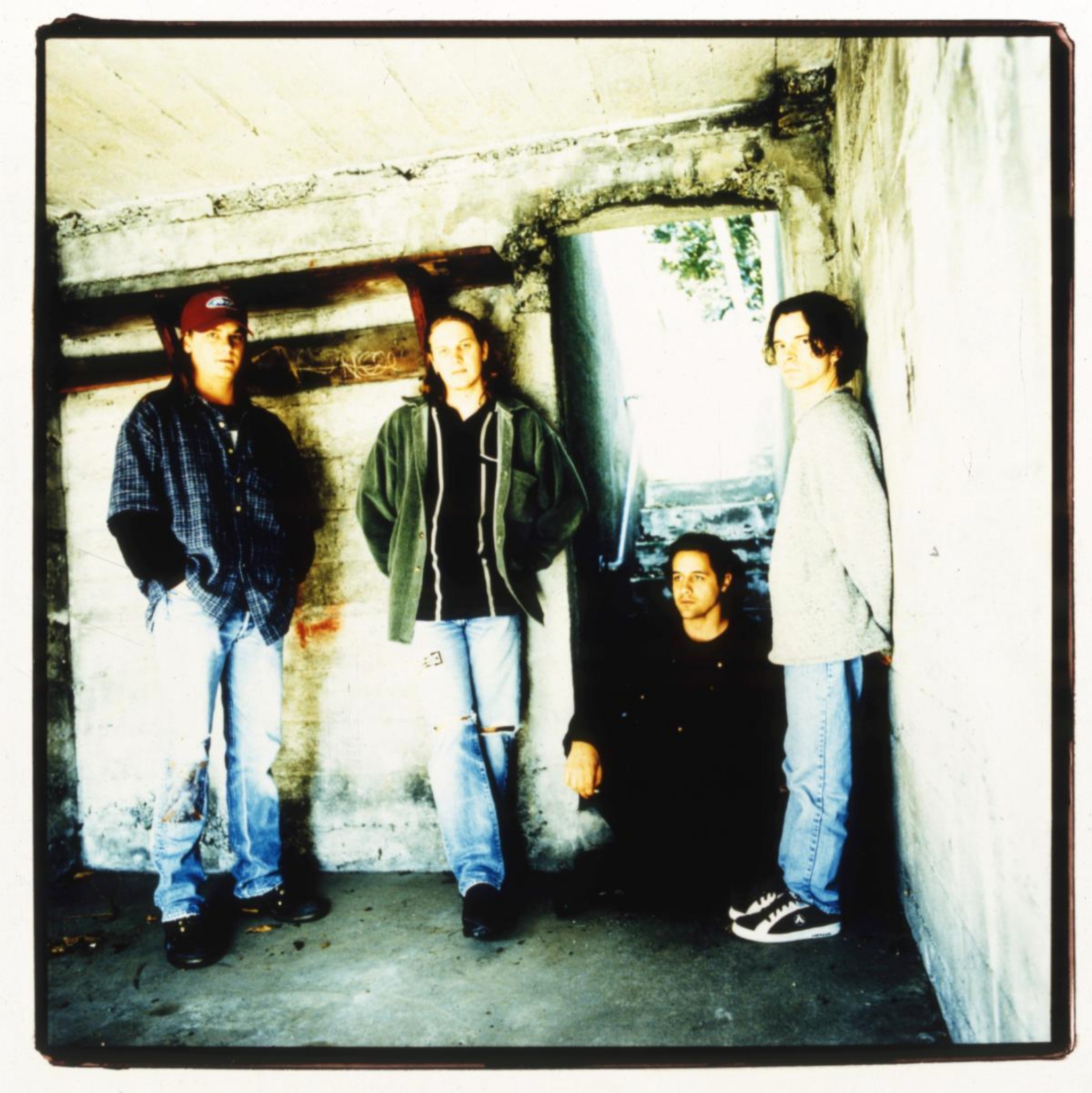
I know. Candlebox.
Go ahead. Get it out of your system.
I first started hearing about them not long after I moved to Seattle in ’92. They were still a pretty new band then, and unlike some of the groups on these pages, there wasn’t ten years of local mythology already attached to them. Kevin Martin and Scott Mercado had been playing together in a short-lived band called Uncle Duke, then Peter Klett came in on guitar, Bardi Martin came in on bass, and by the end of 1991 the four of them were Candlebox. Peter changed the whole thing pretty quickly, from what Kevin has said. The name came from a Midnight Oil lyric, which is already a better origin story than most band names I’ve heard explained at two in the morning.
The really interesting artifact from that period is the demo. They scraped together the money to make an eight-song tape at Robert Lang Studios around Easter 1992, with Kelly Gray producing and engineering with the band. It came on a red cassette, and if you ever see an original one for a sane price, grab it before the guy behind you does. “Change,” “Cover Me,” “Rain,” “Can’t Give In,” “You” and “Far Behind” are all already there. Even better, the versions of “You” and “Far Behind” on the first album are those recordings. They didn’t go back and make shinier major-label versions after getting signed. Those two tracks were already in the can.
That tape started moving around while the band was trying to get decent club dates in a town where suddenly every record-company asshole in America seemed to be looking for the next Seattle band. That didn’t necessarily make things easier if you were an unknown Seattle band. There were already established groups that could fill the rooms, and Candlebox weren’t part of the old Sub Pop/C/Z/Reciprocal family tree. They were another young local rock band trying to get people to come see them. I remember the name starting to come up after I got here, but I’m not going to pretend I was standing in some half-empty club watching history happen. Mostly they were just one more name you started seeing and hearing around town.
The demo eventually helped get them down to Los Angeles for showcases. At one of them, at the Club Lingerie, Guy Oseary from Maverick caught their set and got interested. Maverick signed them in ’92.
Yeah.
Madonna’s label.
Again, the ’90s were fucking weird.
They made the rest of the first album at London Bridge with Kelly Gray and released Candlebox in July 1993. And this is one of those cases where memory tends to squash a year into about five minutes. The record did not come out and instantly sell millions. “Change” started getting some attention, then “You” took off, and the whole thing kept building. By 1994 “Far Behind” was fucking everywhere. Radio, MTV, cars driving past with the windows down. You couldn’t escape that song for a while.
And I still liked it.
Kevin could sing. I mean really sing, which apparently became another thing you could hold against them. Peter Klett was a hell of a guitar player, and the band had songs built for rooms a lot bigger than the ones they had been fighting to get into a couple of years earlier. “You” still has that slow, ugly tension before it opens up, and “Far Behind” works because they don’t blow the whole thing in the first thirty seconds. There’s space in it. Then Klett comes in and does what guitar players used to be allowed to do without somebody accusing them of setting rock music back twenty years.
Candlebox got lumped into grunge because they were from Seattle and happened to show up at exactly the right — or wrong — moment. I never really heard them that way. There was way more straight-up hard rock in what they were doing. Blues stuff. Classic rock. Big choruses. Guitar solos that actually sounded like guitar solos. They weren’t trying to sound like Mudhoney, and they sure as hell weren’t some lost 1988 Sub Pop band that everybody somehow forgot to mention until 1993.
Around Seattle, that distinction mattered.
So did the timing.
By the time Candlebox got national attention, “Seattle” had stopped being merely a place where bands lived and turned into a marketing category. If you came along after Nevermind, people immediately started checking your papers. Were you there early enough? Did the right people know you? Did you have the right records? Were your guitars appropriately fucked up? Candlebox had the additional problem of being on Maverick and writing songs that sounded perfectly capable of surviving on mainstream rock radio. Once they started selling records, all of that became evidence for the prosecution.
Some people around here acted like Candlebox had shown up late, copied the clothes, stolen everybody’s lunch money and walked away with a platinum record. I never thought that was fair. They had been a local band before anybody outside Seattle gave a shit about them, and getting signed didn’t retroactively make those rehearsals, demos and shitty early opportunities imaginary. At the same time, were they part of the same underground world that produced Green River, Mudhoney or Skin Yard?
No.
Not really.
And they didn’t need to be.
They were a Seattle band. They made a demo here, fought for club dates here, got signed, and then got fucking enormous. That happened too. Pretending otherwise because they weren’t cool enough misses part of the story.
And enormous really does mean enormous. The first album kept climbing long after it came out. It went gold in early ’94, then platinum, then multi-platinum, and eventually everybody was throwing around numbers in the neighborhood of four million copies. They opened for Rush on the Counterparts tour, which makes a lot more musical sense when you actually listen to Candlebox instead of staring at Kevin Martin’s hair in an old photograph. That summer they also ended up on Metallica’s big shed tour after Alice in Chains pulled out, and in August they played Woodstock ’94. A band that had been struggling to get decent Seattle club dates a couple of years earlier was suddenly playing to oceans of people.
The bigger they got, the more shit they seemed to get for it. Some of that was ordinary backlash. Some of it was Seattle fatigue. Some of it was people who genuinely thought the band was too conventional, too polished or too hard-rock for all the “alternative” baggage being hung around them. Fair enough. You don’t have to like a record. What always annoyed me was the idea that commercial success proved they had somehow cheated. If selling a lot of records automatically invalidates you, half the bands people use to insult Candlebox are going to have a problem too.
Lucy came out in ’95, right when the backlash was already pretty ugly. I actually like that record more now than I did then. “Simple Lessons,” “Understanding,” “Best Friend.” It’s darker and less immediate than the first one, and there isn’t another “Far Behind” sitting there waving its arms at radio. It still made it high on the charts and went gold, which is only a disaster if the record before it sold several million copies and everybody suddenly expects you to do that for the rest of your life. They also did “Steel and Glass” for that John Lennon tribute around the same time, which is worth tracking down if you’ve only ever heard the albums.
Scott Mercado eventually left in ’97, and Dave Krusen came in on drums.
Yes, that Dave Krusen.
Pearl Jam’s original drummer.
There’s the family tree again.
By the time they made Happy Pills, things had changed considerably. Ron Nevison produced that one instead of Kelly Gray, and it came out in ’98. “It’s Alright” got plenty of rock-radio play, but the album itself never moved anything like the first two. Krusen was gone by the beginning of ’99, Shannon Larkin came in for touring, and Bardi Martin eventually left too. The strange part is that the first Candlebox record was only five years old when Happy Pills came out, but it already felt like it belonged to another version of the music business.
Seattle wasn’t the center of the universe anymore. Radio had found a hundred newer bands to play. All the record-company people who had spent the first half of the decade crawling around this town looking under bar stools for the next Nevermind had moved on to whatever they thought was coming next.
Candlebox finally called it quits in 2000. From what I understand, there was plenty of record-company bullshit involved by the end, but I’m not going to pretend I’ve read their contracts. Kevin’s got another band going now, Kevin Martin & the Hiwatts. I haven’t heard enough of them yet to have much of an opinion.
I still put the first Candlebox record on sometimes. Maybe part of that is because I remember when those songs were absolutely unavoidable, but that usually works against a record after a while, not in its favor. I’ve heard “Far Behind” enough times for several lifetimes. There were years when I would have understood perfectly if somebody begged every radio station in America to give the fucking thing a rest.
And yeah, when it comes on, I usually let it play.
Maybe that makes me uncool.
I work in a record store.
I got used to that a long time ago.