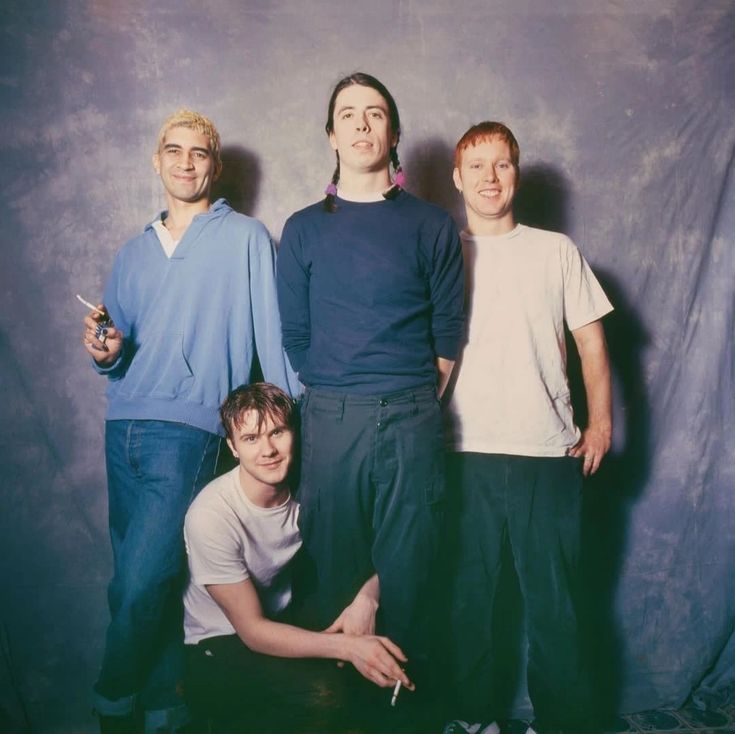
Foo Fighters were never supposed to be Nirvana Part Two.
Thank God for that.
I first heard them in the summer of '95 when the first record showed up at the store. Everybody knew what it was before anybody heard it: Dave's new band. That was the story, anyway. Except it wasn't really a band yet.
Dave had gone into Robert Lang Studios up in Shoreline the previous October with Barrett Jones and recorded almost the whole damn thing himself in about a week. Guitar, bass, drums, vocals. Greg Dulli played guitar on “X-Static,” but otherwise what you're hearing is basically Dave Grohl piling himself on top of himself, making a record before there was a Foo Fighters that could stand on a stage together.
Some of those songs had been kicking around before Nirvana ended. Others came afterward. That's worth remembering because the album gets talked about like Dave disappeared after April '94, walked into a studio six months later and suddenly invented twelve songs because he needed a new career. It wasn't that neat. Musicians write songs. They make tapes. They squirrel things away. Dave had been doing that while he was still the drummer in somebody else's band.
But none of that was what I was thinking about when somebody put on “This Is a Call” at the store.
I stopped what I was doing.
Not because it sounded like Nirvana.
Because it didn't.
That mattered.
“I'll Stick Around,” “Alone + Easy Target,” “Good Grief,” “For All the Cows,” “Exhausted” — there was still plenty of noise in there, but it sounded lighter somehow. Not happy exactly. “I'll Stick Around” sure as hell isn't anybody's sunshine song. I mean lighter like somebody had opened a window after being stuck in the same room for too long. Guitars could buzz and drums could get the shit kicked out of them without every note arriving with three years of baggage attached.
I needed that record more than I expected to.
Seattle was still carrying a lot around in '95. I'm not going to pretend everybody in town felt the same way, because they didn't. I can only tell you how it felt from where I was standing. Maybe I needed to hear Dave playing drums again. Maybe I needed to hear him singing. Maybe he just needed to do it and the rest of us happened to be listening.
Either way, I bought the record.
The funny part was that now he needed an actual band.
Pat Smear had played guitar with Nirvana on the road, and Dave brought him into this new thing. Sunny Day Real Estate had come apart, which made bassist Nate Mendel and drummer William Goldsmith available. So by the time the first album actually came out in July '95, Foo Fighters had become something different from the thing that made it. The record was mostly one guy in a studio. The band going out to play those songs was four people trying to figure out what Foo Fighters sounded like when they were all in the same room.
That's one reason I don't buy the idea that they were just Dave Grohl's solo project with hired hands. They may have started from his tape, but you don't spend months in vans, clubs, theaters and backstage rooms with the same people without becoming some kind of band.
I saw them during those first couple of years, and that's the thing I remember most about Dave: the guy looked like he was having fun.
After everything we'd watched happen, that was almost strange to see. He'd spent years sitting behind a drum kit while Kurt stood out front getting most of the attention. Now Dave was the guy with the guitar, running around, yelling into microphones, talking to the crowd and generally behaving like he'd been doing this his whole life.
Took some getting used to.
It also became obvious pretty quickly that Foo Fighters weren't going away after one record. “Big Me” wound up all over MTV in '96 because of that ridiculous Mentos commercial video, which is still one of the dumbest good ideas anybody has had for getting a song stuck in your head. By then you could walk into the store and ask for Foo Fighters without having to add, “You know, the Nirvana drummer.”
That might sound like a small distinction.
It wasn't.
The Colour and the Shape came out in '97, and that's when I stopped thinking of Foo Fighters as Dave's new band.
They were just Foo Fighters.
“Monkey Wrench.” “Hey, Johnny Park!” “My Poor Brain.” “February Stars.” “Everlong.”
Yeah, “Everlong.”
I don't know what else anybody needs me to say about that one.
Great fucking song.
The record sounds bigger and meaner than the first one, but also more like people fighting their way toward being a band instead of one guy figuring out how many instruments he can play before somebody makes him go home. Which is funny, because making the damn thing nearly tore the lineup apart.
Gil Norton produced it, and Dave wasn't happy with a lot of William Goldsmith's drum tracks. He wound up re-recording most of the drums himself. I'm not going to pretend I know every conversation that happened in those rooms or decide who was right about what. I wasn't there. What I do know is that William left, and by the time the record was out Foo Fighters needed another drummer.
Taylor Hawkins came over after playing on the road with Alanis Morissette, and he looked like he belonged almost immediately. Important distinction for anybody reading liner notes twenty years from now: Taylor joined after The Colour and the Shape was recorded. That's Dave doing most of the drumming you're hearing on that record, not Taylor.
Then Pat left too.
So much for the stable new band.
For a little while Franz Stahl came in on guitar. That made sense in its own weird circular way because Franz and Dave had played together in Scream before Dave ever joined Nirvana. That version of Foo Fighters didn't last, but it did leave a couple of interesting things behind. They recorded “A320” for the Godzilla soundtrack, and they cut a new version of “Walking After You” for The X-Files movie soundtrack. Same song as the one on The Colour and the Shape, but not the same recording. This is exactly the kind of shit that makes record collectors buy the same song twice and then defend the decision like we're in court.
Eventually Franz was gone too.
At that point Foo Fighters were Dave, Nate Mendel and Taylor Hawkins, and instead of immediately finding another guitar player they made the next record as a trio.
There Is Nothing Left to Lose came out in '99. They'd made the record mostly at Dave's house back in Virginia with Adam Kasper, away from the whole giant-studio pressure cooker, and you can hear the difference.
Different record.
Less desperate. More room in it.
“Stacked Actors” still hits hard, but then you've got “Ain't It the Life,” “Next Year,” “Aurora”...
I love “Aurora.”
And “Learn to Fly,” which I'm pretty sure I've heard enough times in the store to last me until about 2015.
Still a good song.
Don't tell Dave I said that.
The video didn't exactly help with the overexposure. Dave, Nate and Taylor running around dressed as half the people on an airplane, Tenacious D turning up, everybody apparently deciding dignity was somebody else's problem. It was stupid in exactly the right way.
I think There Is Nothing Left to Lose might actually be my favorite Foo Fighters record so far. The first one means more to me for reasons that probably don't have much to do with whether it's actually the better record, and The Colour and the Shape has songs that are going to follow this band around forever. But There Is Nothing Left to Lose sounds comfortable without sounding lazy. It doesn't seem worried about proving that Dave can front a band anymore. He can. Question answered.
Chris Shiflett joined on guitar after the record was finished, so the band went back to being a four-piece: Dave, Nate, Taylor and Chris. Chris had been playing with No Use for a Name, which is a pretty good résumé if you're going to walk into a band that already has three albums and a whole lot of people who think they know exactly what it should sound like.
By now they're a major rock band. MTV, radio, big tours, a Grammy for There Is Nothing Left to Lose, the whole machinery. That's another thing that's strange to think about. In '95 they were the band everybody introduced by explaining who Dave used to play drums for. Seven years later that explanation isn't necessary anymore.
Good.
There are still plenty of little side roads if you're dumb enough to start chasing them. Their cover of Gary Numan's “Down in the Park” turned up on Songs in the Key of X. They did Gerry Rafferty's “Baker Street.” “A320” is sitting on a Godzilla soundtrack next to a bunch of other late-'90s debris, and the alternate “Walking After You” is over on The X-Files. More recently they put “The One” on the Orange County soundtrack. Foo Fighters are one of those bands where buying the albums gets you most of the story and then the singles and soundtracks start whispering, Hey asshole, you missed something.
I know that voice.
They're working on another record now. From what I've heard, they've been recording both down in Virginia at Dave's place and out in Los Angeles. That's about all I know, and I'm not going to fill the blank space with rumors just so this page looks more informed than it is.
It'll come out when it comes out.
Looking back, I think that's why Foo Fighters matter to me.
Not because they're carrying some Seattle torch. They're not. And not because they're the continuation of Nirvana.
They definitely aren't.
It's because for a while after April '94 it was hard to imagine what came next. Not just with Dave. With a lot of this music. The whole thing had gotten so big and so ugly and so fucking sad that sometimes it felt like every guitar coming out of Seattle was going to arrive already wearing a black armband.
Then this stupid little record showed up with a ray gun on the cover and Dave playing almost everything himself.
And something came next.
It wasn't Nirvana.
It wasn't supposed to be.
Good.