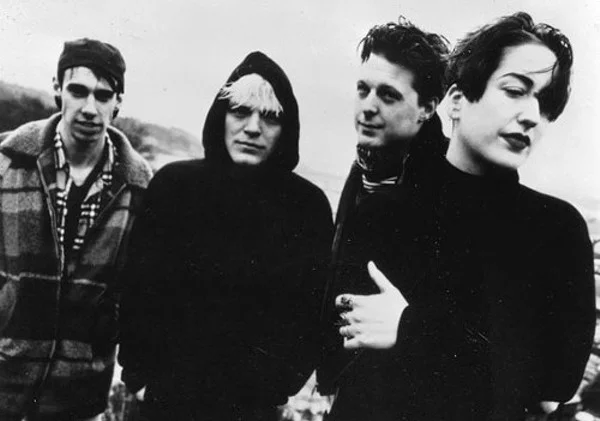
Hammerbox caught me at exactly the right time.
I first heard them back in Queens in ’91.
Somebody at the store had their first record, the one on C/Z, and Carrie Akre’s voice got me immediately.
She could really sing.
I don’t mean that as some backhanded thing about punk singers. Carrie just had this huge voice that could cut straight through the guitars without sounding like she was fighting them. Loud without turning into screaming all the time. Strong without getting slick.
“Bred,” “Size of the World,” “Ask Why,” “When 3 Is 2.”
I played that record a lot.
They’d actually put out a 7" before it, “Kept House” backed with “After All,” on a little Seattle label called Big Flaming Ego. “Kept House” made it onto the album. “After All” didn’t. That’s the kind of single that gets harder to find right around the time you decide you need one.
The album came out on C/Z in ’91, but most of it had been recorded over a couple of days at the end of 1990, with Ed Brooks producing along with the band. And it really does sound like a band. That sounds obvious, but I mean all four people pushing the same songs around rather than a singer with three guys standing behind her.
Carrie Akre singing. Harris Thurmond on guitar. James Atkins on bass. Dave Bosch on drums.
Four people.
Nice and simple for once.
No family tree required.
Well, not yet anyway.
Harris deserves more credit than he usually gets when people talk about Hammerbox, because Carrie’s voice is the first thing everybody notices. He was a big part of why those songs moved the way they did. The first record credits the songs and arrangements to Hammerbox, and that makes sense when you listen to it. The guitar doesn’t just sit underneath Carrie. It keeps shoving the songs forward while the bass and drums keep the whole thing from flying apart.
By the time I moved to Seattle the following year, Hammerbox were one of those bands I already knew from records but suddenly started seeing mentioned everywhere around town. And I started realizing how many records in my collection had that little C/Z logo hiding somewhere on the back.
Then A&M signed them.
Of course they did.
By 1992 every major label seemed convinced there was another Nirvana hiding behind a dumpster somewhere in Seattle.
Hammerbox weren’t some band that appeared after Nevermind, though. That’s important. They already had the single. They already had the C/Z record. They were already playing around here. The major-label feeding frenzy just caught up with them.
Numb came out in ’93.
I remember being surprised by how big it sounded compared to the first record. Michael Beinhorn produced it, with Paul McKenna engineering and mixing, and Beinhorn ended up producing Soundgarden’s Superunknown the following year. I’m not saying one had anything to do with the other. It’s just funny looking at those credits now.
Numb has that kind of scale to it.
But it still sounds like Hammerbox.
“Hole” is a hell of an opener. Then there’s “Hed,” “Blur,” “Outside,” “Trip.”
And “When 3 Is 2.”
Again.
Except they didn’t just stick the old C/Z recording on there. They went back and cut the damn thing all over again with Beinhorn. A&M even put that version out on a CD single with “Rain” and an acoustic version of “No.”
I’ve always liked that. Somebody involved with that record obviously knew the song deserved another shot.
A&M did make an effort with Numb. That gets lost sometimes when people reduce the whole story to “major label signs Seattle band and screws them.” There were singles for “Hole,” “Hed” and “When 3 Is 2.” Hammerbox toured. They played with bands like King Missile, Sloan and Redd Kross. They got overseas.
And then there was Endfest.
August ’93, over at the Kitsap County Fairgrounds in Bremerton. Catherine Wheel, Hammerbox, Belly, They Might Be Giants, X, Social Distortion, Helmet and a bunch of others. The paper said fifteen thousand people were there.
Fifteen thousand.
Hammerbox apparently decided the appropriate response to this was to throw Twinkies into the crowd.
Which, honestly, may have been the correct response.
For a little while it looked like things might actually happen for them. They had A&M behind them, a new record, singles, touring, big festival crowds. Not “next Nirvana” shit. I don’t mean that. Just that you could look at Hammerbox in the middle of 1993 and reasonably think there was going to be another record after Numb, and another tour after that.
There wasn’t.
Numb didn’t turn into the record A&M needed it to be, and the label didn’t keep going with them. I don’t know what number somebody had written on a piece of paper in an office somewhere, and I’ve never seen a sales figure I trust enough to repeat. What matters is what happened next.
Or didn’t.
That part of the Seattle story doesn’t get talked about nearly as much.
Once Nevermind blew up, labels signed an unbelievable number of bands around here. Everybody remembers the ones that sold millions. There were plenty of others who got signed, made one record for a major, got thrown out on the road and then discovered that having a major-label logo on the CD didn’t guarantee there would be another one.
Hammerbox were one of those bands.
James Atkins left in early ’94.
Carrie left later that year and started Goodness.
And that was basically the end of Hammerbox.
No replacement singer. No second version of the band stumbling along for another three years. No third album that I can point you toward and tell you everybody missed it.
Two records.
That’s the story.
Carrie didn’t exactly disappear, though.
Goodness became one of those names you didn’t need explained if you spent enough time around Seattle clubs in the second half of the ’90s. She’s also been singing with the Rockfords, the band with Mike McCready, and she put out her own record, Home, in 2000.
Carrie just kept singing.
So Hammerbox feels less like a band that disappeared and more like one chapter in a much longer story.
I still go back to that first C/Z record more than Numb.
That isn’t a knock on Numb. There are days when I want the big guitars and “Hole” coming through the speakers like somebody just kicked the door open.
But the first one is still mine.
Maybe because that’s how I heard them first, three thousand miles away from Seattle.
Maybe because most of it was recorded in two days before anybody outside the Northwest had decided every Seattle guitar band might be worth a major-label contract.
Maybe because it sounds like four people in a room figuring out exactly how hard they can push a song without breaking it.
Whatever.
Put on “Bred.”
Then turn it up until Carrie’s voice is sitting on top of everything else.
That record still works.
And Carrie can still sing her ass off.