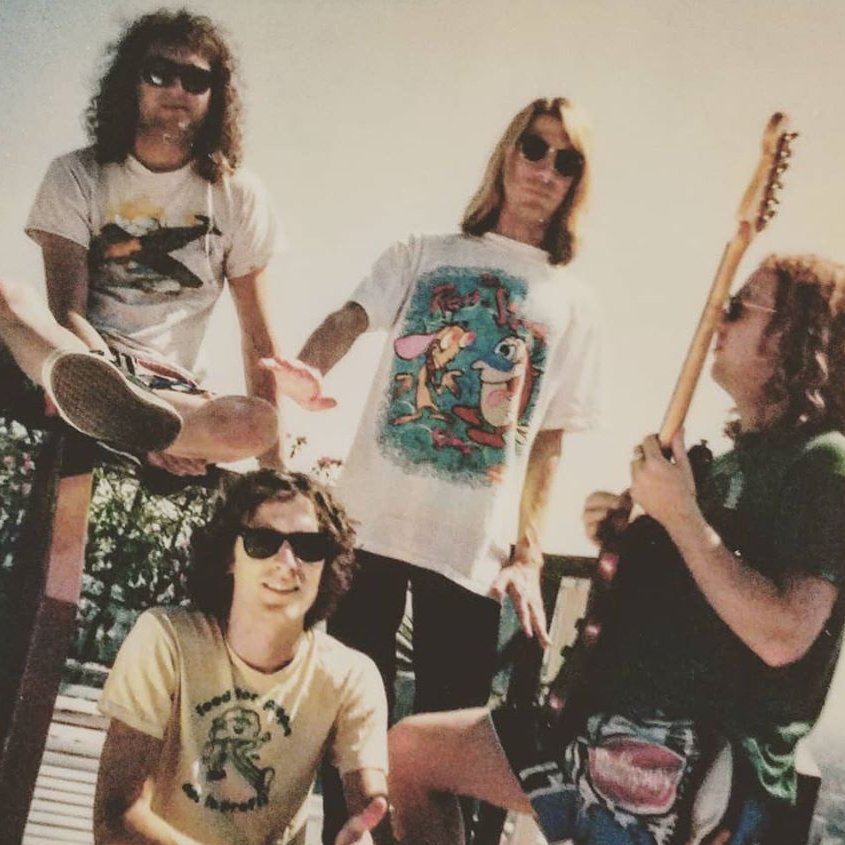
Mudhoney might be the most Seattle band I can think of.
I don't mean the biggest. Obviously.
I don't mean they invented anything, either. People love inventors after the fact. Somebody invented grunge, somebody invented the Seattle sound, somebody invented flannel, somebody invented distortion, and pretty soon you've got six guys all supposedly inventing the same thing in different basements.
I mean Mudhoney.
I first heard “Touch Me I'm Sick” sometime around '89 or '90, back in Queens. Somebody had a copy of the Sub Pop single and it sounded completely fucked up. Fuzz everywhere, Mark yelling like an idiot, drums pounding away underneath it. I loved it immediately.
Then I found Superfuzz Bigmuff and that pretty much finished the job.
Mudhoney were one of the bands that made Seattle seem like this strange place on the other side of the country where everybody owned a distortion pedal and nobody knew how to wash their clothes. I knew absolutely nothing about the geography involved. Seattle, Olympia, Tacoma, Aberdeen, whatever. It was all Washington to me. Records would turn up with these blurry black-and-white photographs of people throwing themselves around clubs, and Sub Pop seemed less like a record company than some scam being run out of a damp basement.
Which, financially, may not have been that far off.
Of course, when I finally moved here I found out Seattle was mostly coffee, rain and people complaining about parking, but the records still sounded great.
The story starts a lot earlier than Mudhoney, though, and this is where people like to draw one of those family trees that makes Seattle look like twelve people changing band names for fifteen years.
There's some truth to that.
Mark Arm was Mark McLaughlin before he was Mark Arm, and before Green River he was already making noise with Mr. Epp and the Calculations, one of those early Seattle punk bands where the joke and the band were difficult to separate. Mark was using the word “grunge” way back in 1981, in a letter describing Mr. Epp as “pure grunge! pure noise! pure shit!” This occasionally gets transformed into MARK ARM INVENTED GRUNGE, which is exactly the kind of historical bullshit that happens when a word eventually becomes worth money.
He used the word.
He did not walk down from a mountain carrying two stone tablets labeled GRUNGE.
Mark and Steve Turner had already been playing together around that early Seattle punk mess, including Limp Richerds, before both ended up in Green River. Green River matters here, obviously, but I hate when those guys get described entirely by what happened afterward. They weren't a waiting room for Mudhoney and Pearl Jam. They were a band. A really good and frequently fucked-up band, too.
Steve actually left Green River before Green River itself was finished. The usual explanation is that the music and ambitions were moving somewhere he didn't particularly want to go — heavier, more rock, more interested in what a bigger label might mean — while Stone Gossard and Jeff Ament were increasingly interested in seeing how far the band could go. That's true enough as an outline, but band histories always become cleaner after everybody stops arguing.
Mark stayed until Green River finally came apart.
Stone and Jeff went toward what eventually became Mother Love Bone.
Mark and Steve found their way back to each other.
Then you needed a rhythm section.
Matt Lukin had played bass in the Melvins, back when they were still crawling out of Montesano and Aberdeen and figuring out exactly how slow you could play before somebody checked you for a pulse. Buzz Osborne and Dale Crover eventually headed south for a while; Matt stayed up here. Dan Peters came from Bundle of Hiss.
And that gave you Mark Arm, Steve Turner, Matt Lukin and Dan Peters.
The date they always give for the first full practice is January 1, 1988.
That's such a suspiciously perfect date for starting a band that I almost don't want to believe it.
New Year's resolution: make horrible noise.
By most accounts their first real club gig came that April at the Vogue, opening for Das Damen. Within a few months they had already stumbled onto the thing that would follow them around for the rest of their lives.
“Touch Me I'm Sick.”
It was recorded at Reciprocal with Jack Endino and released by Sub Pop as SP18 in the summer of 1988, backed with “Sweet Young Thing Ain't Sweet No More.”
If you want the short version of early Mudhoney, put that record on.
Not because it's the only thing they could do. It isn't. But almost everything people later decided was “Seattle” is sitting in there waiting to be exaggerated by somebody else. Garage rock. Punk. Stooges damage. A little blues dragged through something filthy. A riff that sounds like it should fall apart but doesn't. Mark sounding simultaneously disgusting, funny and completely serious.
And fuzz.
Jesus Christ, the fuzz.
One of the things I love about those early Mudhoney records is that the distortion doesn't make the music feel bigger in the normal heavy-metal sense. It makes it feel damaged. Steve Turner's guitar sounds like somebody dropped a radio into a bathtub.
The band weren't hiding the machinery, either. The name Superfuzz Bigmuff came right out of the fuzz boxes: Mark and the Super-Fuzz, Steve and the Big Muff. There's a beautiful stupidity to naming a record after the pedals you're using to ruin the sound.
That's Mudhoney all over.
Jack Endino was important, too. Reciprocal was important. Sub Pop was important. But this is another place where history gets backward. Endino didn't invent the band because he recorded them, and Sub Pop didn't manufacture Mudhoney because they put the records out. What happened was that a band, a producer, a label, a photographer and a particular little scene all became extremely useful to each other at almost exactly the right moment.
Bruce Pavitt and Jonathan Poneman were turning Sub Pop into something with an identity. Jack could make these bands sound huge without sanding all the ugly parts off. Charles Peterson's photographs made sweaty little rooms look like riots. And Mudhoney were loud, funny, visually great and just fucked-up enough to make the whole thing seem like a movement before there really was one.
“Touch Me I'm Sick” was perfect for that.
It also traveled.
That's worth remembering now because everybody thinks Seattle became important the day “Smells Like Teen Spirit” showed up on MTV. Long before that, records like SP18 were getting mailed, traded, reviewed and carried around by people who cared about this stuff. That's how one could end up in Queens.
That's how one ended up in front of me.
Sonic Youth heard it too.
That connection produced one of my favorite stupid little artifacts from the whole period: the 1988 split single where Sonic Youth did “Touch Me I'm Sick” and Mudhoney covered Sonic Youth's “Halloween.”
There are people who call the Sonic Youth side “Touch Me I'm Dick.” That's a good joke.
It isn't the title on the fucking record.
The first Superfuzz Bigmuff was a six-song 12" EP: “Need,” “Chain That Door,” “Mudride,” “No One Has,” “If I Think” and “In 'n' Out of Grace.” Recorded at Reciprocal, Jack Endino again, Charles Peterson photographs, six songs of a band already sounding completely like itself.
But here's where record-store history and regular history start becoming two different things.
If you came to Mudhoney later, like I did, there was a decent chance the Superfuzz Bigmuff you encountered was the 1990 Plus Early Singles CD, which threw a pile of the early 7" material in with the EP. “Touch Me I'm Sick,” “Sweet Young Thing,” “You Got It,” “Burn It Clean,” “Hate the Police,” “Halloween.”
Very convenient.
Also very dangerous, because after a few years you start remembering all those songs as if they were always one record.
They weren't.
This is the kind of thing that keeps record collectors awake at night while normal people have sex.
By 1989 Mudhoney were becoming a much bigger deal in a very small world.
Sub Pop understood publicity. That's one thing nobody should ever take away from them. They understood that selling a place could help sell the records, and British music papers were especially receptive to the idea that something strange was happening way up in the Pacific Northwest.
So suddenly you've got journalists coming over, Charles Peterson photographs everywhere, words like “Seattle” and “Sub Pop” starting to mean something to kids who couldn't find Washington on a map, and Mudhoney right in the middle of it.
That year they went over to Britain as part of the Sub Pop package with TAD and Nirvana.
Think about that bill now.
Then try not to think about it now.
That's the trick.
Nirvana weren't Nirvana yet in the sense people mean when they say the name today. They were another Sub Pop band. TAD were terrifying. Mudhoney were the name people were waiting for. The British press made a lot of noise about all of them, and the idea of Seattle as a place with a particular sound got larger every time somebody wrote another article.
Some of that attention was real enthusiasm.
Some of it was marketing.
Some of it was journalists discovering that three bands from the same city made a better story than three unrelated bands.
That's how scenes become genres.
Mudhoney's first full-length came out in 1989, just called Mudhoney.
It's a meaner, broader record than the mythology around “Touch Me I'm Sick” sometimes lets people remember. “This Gift,” “Flat Out Fucked,” “Get Into Yours,” “Here Comes Sickness,” “When Tomorrow Hits,” “Dead Love.” There's garage rock in it, punk, noise, psychedelic garbage, the Stooges, the Scientists, the Sonics, all these records Mark and Steve had absorbed and then apparently left too close to an electrical fire.
“When Tomorrow Hits” is one of those songs where Mudhoney's stupidity and intelligence meet in exactly the right place.
I mean that as a compliment.
A lot of bands can sound dumb.
It takes work to sound dumb this well.
That's another thing that gets missed when people write solemnly about the BIRTH OF GRUNGE. Mudhoney were funny. Not novelty-band funny. Not Weird Al funny. They just never seemed particularly interested in treating rock and roll as sacred property.
Mark Arm has always been one of my favorite frontmen around here because of that. He's funny, sarcastic and never seems particularly interested in convincing anybody that what he's doing is important. Dan Peters hits the drums like they owe him money. Matt Lukin always looked like he'd wandered into the wrong building and decided to stay.
And Steve just keeps making that guitar noise.
That lineup made some of my favorite records from those years.
They also kept touring while Sub Pop kept getting more famous and apparently no better at having money.
By 1990 and 1991 the whole Seattle thing was in a strange position. People outside the Northwest who followed underground music knew something was happening. British papers had been yelling about it. Major labels were sniffing around. Sub Pop had a recognizable logo, recognizable photography, recognizable bands and, from everything anybody could tell, a remarkable ability to be broke anyway.
Then Mudhoney made Every Good Boy Deserves Fudge.
That's probably still the one I play most.
Superfuzz Bigmuff is the obvious answer, I know.
Fuck the obvious answer.
Every Good Boy came out in 1991 and sounds different from the early records without suddenly becoming respectable. Conrad Uno recorded it at Egg Studios, and there's more air in the thing. Organ. Harmonica. Garage rock crawling out from underneath the fuzz. The band sounds less like it's trying to knock a wall down and more like it's discovered there are twelve different ways to make the wall look stupid.
“Good Enough” is ridiculous.
So is “Let It Slide.”
“Into the Drink.”
“Shoot the Moon.”
“Something So Clear.”
“Fuzzgun '91.”
It's one of those records where every time I put it on for one song I end up leaving it on.
There are stories now about that record saving Sub Pop. Maybe it helped. The label was certainly having money trouble, and Mudhoney were one of the bands that could actually move records before Nirvana turned the entire scale of the conversation upside down.
But I've heard enough heroic record-company stories to know that whenever somebody says ONE ALBUM SAVED THE LABEL, somebody should probably ask to see the books.
So let's just say it sold.
People cared.
And then Nevermind happened.
There are entire books to be written about what that did to Seattle. Probably too many of them already.
For Mudhoney the funny part is that they had spent years helping create the conditions for somebody to become enormous, and then somebody else became enormous.
That isn't injustice.
That's rock and roll.
Nirvana had songs Mudhoney didn't have. Mudhoney had things Nirvana didn't have. The fact that they came from overlapping circles and shared labels and stages does not mean history owed everybody the same number of records sold.
Dan Peters even briefly wandered into Nirvana's history before Dave Grohl arrived. He played on “Sliver” and did one show with them in September 1990.
One.
So no, he was not “Nirvana's drummer” in any useful sense.
He was Dan Peters.
By 1992 the major labels had stopped sniffing around Seattle and started eating the furniture.
Mudhoney signed with Reprise.
When I heard about that, I remember wondering what the hell a major label was going to do with Mudhoney.
This was a band whose name came from a Russ Meyer movie, whose most famous record sounded diseased and whose entire visual identity seemed to involve sweat, cheap beer and Mark Arm's hair being somewhere gravity hadn't intended.
Now Warner Bros. money was involved.
Sure.
Why not.
The answer, at least at first, was basically let them keep being Mudhoney for a while.
Piece of Cake came out in 1992.
“Suck You Dry” was the one that got pushed hardest, and it's a great fucking song. “Blinding Sun,” “Acetone,” “No End in Sight,” “Make It Now,” “Ritzville.” The record is cleaner around the edges than the Sub Pop stuff, because of course it is, but nobody seems to have dragged Mark into an office and asked him to write “Jeremy.”
It still sounds like Mudhoney.
Maybe that's why the whole major-label thing with them always seemed slightly absurd to me. The machinery around the band had changed enormously, but the product being fed into the machinery was still these four guys.
And right around then, I finally got here.
I moved to Seattle in September 1992.
The timing was ridiculous.
I had spent years imagining this place through Sub Pop singles and Charles Peterson photographs, and by the time I arrived the rest of America had discovered it too. Nevermind had been out a year. Pearl Jam was enormous. Soundgarden was getting there. Record-company people were suddenly interested in bands they wouldn't have returned a phone call from three years earlier.
You'd walk around and see evidence of this thing I had imagined from Queens, except it didn't feel anything like the imaginary version.
Of course it didn't.
Cities aren't record labels.
There were no giant fuzz pedals hanging from the Space Needle.
People had jobs.
People got pissed about rent.
People complained about traffic.
People who had been going to these shows for years were already sick of hearing the word “grunge.”
And then, barely a month after I got here, I went to see Mudhoney.
October 4, 1992.
Crocodile Cafe.
That one I remember.
I went for Mudhoney.
This point has become weirdly necessary to make because Nirvana showed up and opened the fucking show.
They played under the name Pen Cap Chew. This was less than a year after Nevermind had turned them into one of the biggest bands in the world, and there they were opening for Mudhoney in a club.
You can imagine what happened to everybody's memory of the night afterward.
The Nirvana part became THE STORY.
Of course it did.
I remember them ripping through “Mexican Seafood,” “Beeswax,” “D-7,” “Curmudgeon,” “Pen Cap Chew,” plus songs I didn't know yet. Dave yelled for “Teen Spirit” at one point. Kurt thanked everybody for letting them pretend they were still underground.
It was funny.
It was also fucking surreal.
But Mudhoney were the band I'd gone there to see.
That's something I always feel a little bad about when people talk about that show. Mudhoney somehow became the footnote at their own gig because the biggest band in the world decided to open for them.
They were great anyway.
And seeing them then, after hearing them for years from the other side of the country, did something useful to the imaginary Seattle in my head.
It killed it.
Good.
The real band was better.
Not cleaner. Not more mythic. Just a band in a room, Mark being Mark, Steve making that horrible guitar noise, Dan beating the hell out of the drums and Matt holding down the bottom of it.
The records hadn't lied.
I'd just built too much scenery around them.
That was probably the beginning of me understanding Seattle properly.
Not as a scene in a magazine.
As a place where bands lived.
Mudhoney kept going.
That's the part of their story I think gets less attention because there's no clean dramatic event attached to it.
Piece of Cake didn't turn them into Nirvana.
So they made another record.
Well, first they made Five Dollar Bob's Mock Cooter Stew, because apparently somebody had to.
That 1993 EP is exactly the sort of Mudhoney object that makes discographies fun. Not THE NEXT MAJOR STATEMENT. Not the record that changed America. Just more stuff from a band that kept recording stuff.
Meanwhile Seattle was getting completely ridiculous.
Every band with a Washington return address seemed to have an A&R guy standing behind it. People who had spent years ignoring this music were suddenly trying to identify the next Nirvana, which was a wonderful way to miss what made most of these bands interesting in the first place.
Mudhoney were particularly badly suited to becoming the next anybody.
Then came My Brother the Cow in 1995.
I like Piece of Cake.
I think My Brother the Cow is better.
There. I said it.
It feels nastier to me. Funnier. More irritated. Like whatever novelty there had been in watching the music industry discover Seattle had worn off and now everybody had to live with the consequences.
“Judgment, Rage, Retribution and Thyme.”
“Generation Spokesmodel.”
“Into Yer Shtik.”
“F.D.K.”
“Orange Ball-Peen Hammer.”
“Execution Style.”
“1995.”
Even the titles sound annoyed.
“Into Yer Shtik” in particular has exactly the kind of industry disgust that made sense by then. The whole business had spent years turning personality into marketing and then acting surprised when bands became hostile about it.
The funny thing is Mudhoney had never needed to pretend they were above any of this.
That's an important distinction.
I don't buy the version of the story where Mudhoney were these noble underground monks who rejected fame while everybody else sold out. They signed to Reprise. They made videos. They toured. They wanted people to buy the records.
Of course they did.
They just never seemed willing to redesign themselves around the possibility.
There's a difference.
Mark and Steve also kept Monkeywrench going on and off with Tim Kerr, Tom Price and Martin Bland, which is worth mentioning mostly because side projects can make a band's timeline look more unstable than it really was.
Steve Turner did not leave Mudhoney in the '90s.
I've heard that one.
No.
He was still there.
The band was still there.
By the middle of the decade, though, the world around them was changing again. The Seattle feeding frenzy had burned itself out. Kurt was dead. Major labels had signed more bands than they knew what to do with. “Alternative” had become a radio format, which is about the fastest way human beings have invented to make a word meaningless.
And Mudhoney were still making Mudhoney records.
That became its own kind of joke.
Not because the records were identical.
They weren't.
That's another myth I don't buy: that Mudhoney never changed.
The early records are not Every Good Boy. Every Good Boy is not Piece of Cake. My Brother the Cow is not Tomorrow Hit Today.
The identity stays recognizable.
The records move.
Tomorrow Hit Today came out in 1998, still on Reprise, and by then having Mudhoney on a major label felt almost like somebody had forgotten to cancel a subscription.
They went down to Memphis and worked with Jim Dickinson, which makes more sense when you hear the record than it does when you read the sentence.
There's more blues rot in it.
More space.
“A Thousand Forms of Mind,” “I Have to Laugh,” “Oblivion,” “Try to Be Kind,” “Poisoned Water,” “Night of the Hunted.”
It doesn't sound like four guys trying to recreate 1988.
Thank God.
The world didn't particularly care.
Or at least the part of the world that decides how much money gets spent telling the rest of the world to care didn't particularly care.
The relationship with Reprise was finished by 1999.
Then Matt Lukin quit.
That one felt different.
Matt had been there from the first practice. Eleven years. Same four guys.
You don't get that often.
By June 1999 he was done with touring and wanted out. Around the same time the Reprise relationship was over, and suddenly Mudhoney really did seem to be sitting there with two of the things that had defined the band — the original four-piece lineup and the major-label deal — gone at once.
For a minute there I honestly thought that might be it.
I don't remember anybody announcing MUDHONEY HAVE BROKEN UP.
It was worse than that, in a way.
They were just in limbo.
That's how bands usually disappear anyway. Not with a press conference. Everybody says they're taking a break, somebody starts doing something else, another year goes by, and eventually you realize you haven't seen the name in a while.
Then Sub Pop put out March to Fuzz in January 2000.
Two CDs.
The first disc is the career.
The second disc is the disease.
Singles, B-sides, covers, weird shit.
That's my kind of compilation.
It also felt a little like a tombstone.
Here is Mudhoney.
1988–1999.
Thanks for coming.
And if you're the kind of idiot who spent years looking through boxes for old 7"s, March to Fuzz was both wonderful and slightly insulting because suddenly a lot of the crap you'd been chasing was sitting right there on the second CD.
This is the eternal conflict of record collecting.
“I want everybody to hear this.”
followed immediately by:
“Wait, not like that.”
Matt actually came back for a short run of shows around the end of 2000 and beginning of this year. His last one with the band was here in Seattle in January.
After that the bass situation got a little loose for a while.
Steve Dukich from Steel Wool filled in for some shows. He wasn't suddenly THE NEW BASS PLAYER. He was helping out.
And then Guy Maddison started playing with them.
Guy had played with Mark in Bloodloss, so this isn't exactly some stranger answering an ad on a telephone pole. They've been doing shows with him on bass this year, and as of right now that seems to be where Mudhoney are.
More importantly, they're recording.
Mark was talking last month about going into different studios and working on songs for a new album. No title that I've heard. No release date. No idea exactly what's going to happen with it.
Good.
For once I'd like to reach the next Mudhoney record without already knowing its entire fucking biography.
So apparently they're not finished.
Apparently not.
And this is where I get back to that first sentence.
Mudhoney might be the most Seattle band I can think of.
Again, not the biggest.
If you want biggest, go count record sales.
Not the most influential, because I'm not interested in turning bands into baseball statistics.
Not the inventors of grunge.
Please stop inventing inventors.
What I mean is that if I follow Mudhoney backward, I keep running into the history of this place.
Mr. Epp.
Green River.
Melvins.
Bundle of Hiss.
The Sonics and all that older Northwest garage damage underneath everything.
Sub Pop.
Reciprocal.
Jack Endino.
Charles Peterson.
Tiny records traveling across the country.
British journalists discovering Seattle.
Nirvana opening for them before Nirvana became Nirvana.
Then Nirvana opening for them again after Nirvana had become fucking NIRVANA.
Sub Pop being broke.
Sub Pop not being broke.
Major labels.
Reprise.
MTV.
The entire world staring at Seattle.
The entire world getting bored with Seattle.
And Mudhoney still standing there after everybody looked away.
That's what I mean.
They aren't a museum piece from “the grunge era” because they didn't stop when the era did.
And they aren't unchanged survivors because that's bullshit too.
They got older.
The records changed.
The business around them changed.
The city changed.
People left.
People died.
Matt finally decided he'd had enough.
The bass player changed.
The label changed.
The size of the crowds changed.
What stayed was something harder to describe.
Maybe it's Mark's voice.
Maybe Steve's guitar.
Maybe Dan hitting the drums like they still owe him money.
Maybe it's the fact that Mudhoney can take something genuinely ugly and make it funny without turning it into a joke.
Maybe it's just four — now three plus whoever is playing bass — guys with really good record collections making exactly the kind of racket those record collections would lead you to expect.
I don't know.
I know that when I was in Queens, Mudhoney helped me invent Seattle in my head.
Then I moved here and discovered that Seattle wasn't that place.
Good.
I've lived here nine years now.
The fantasy wore off a long time ago.
The rain isn't romantic when you're waiting for a bus.
Nobody looks cool carrying groceries.
Clubs close.
Neighborhoods change.
Record stores disappear.
People get real jobs.
People complain about how much better everything was five years before you got there.
Then five years later you're the asshole doing it.
Trends came and went. Bands got huge. Bands broke up. Labels lost interest. People moved away.
Mudhoney just kept being Mudhoney.
Whatever the hell that means.
I think I'm finally starting to understand it.