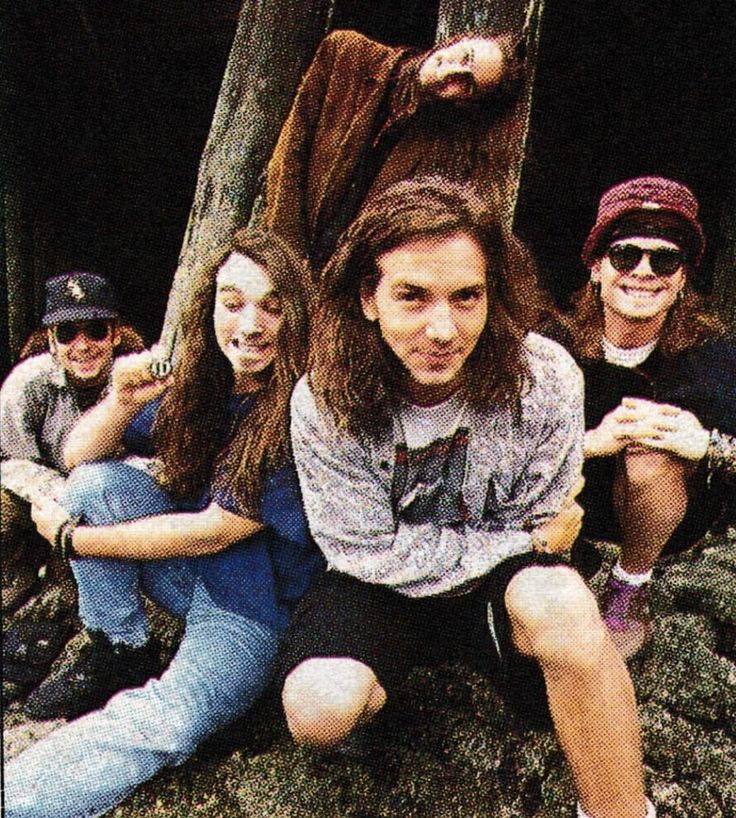
Pearl Jam… I feel like I've been watching these guys grow up for the last ten years, which is a strange thing to say about a band I didn't actually see play until they were already fucking enormous.
I first heard them in the late summer of '91, back when I was still in Queens. Somebody at the record store put on Ten one slow afternoon. I remember Eddie's voice getting my attention first, but it was the guitars that kept me listening. "Alive," "Black," "Porch" — by the end of that year I'd pretty much worn the record out. They weren't unavoidable yet. That's important to remember now, because Ten has become one of those records that feels like it must have arrived already gigantic, as if somebody pressed a button in August 1991 and twelve million people immediately grew flannel shirts. It didn't happen that way. The record hung around, people found it, MTV found it, radio found it, Pearl Jam toured their asses off, and by the following summer the whole thing had gone completely insane.
Then I moved to Seattle in September '92 and Pearl Jam were suddenly everywhere.
I mean everywhere.
Ten had taken off, Lollapalooza had just happened, "Jeremy" was all over MTV, the Singles soundtrack was sitting in record stores, and Seattle itself had turned into this thing people outside Seattle thought they understood. I had spent years in Queens buying records from bands out here and imagining some damp little punk-rock kingdom in the Northwest. Then I actually moved here and discovered a city full of people going to work, paying rent, bitching about traffic, playing in bands, quitting bands, starting other bands, and occasionally having to explain to somebody from California that no, we did not all know Eddie Vedder.
Pearl Jam were particularly weird because they were both completely tied to the history of the local scene and treated by some people as though they'd been assembled in a major-label laboratory six months earlier.
They hadn't.
You have to go back through Green River first. Stone Gossard and Jeff Ament had already been part of that band with Mark Arm, Steve Turner and Alex Vincent, and Green River was one of the groups that helped establish the whole filthy mixture of punk, hard rock and whatever else people later decided to call grunge. When Green River split, Stone and Jeff eventually wound up in Mother Love Bone with Andrew Wood, Bruce Fairweather and Greg Gilmore. Mother Love Bone were a different animal — bigger gestures, more glam, more old-fashioned rock-star electricity — and for a while it looked like they might be the Seattle band that broke through first.
Then Andrew Wood overdosed in March 1990 and died a few days later.
That's one of those points in Seattle music history where people like to draw a clean line because clean lines make good magazine articles. Mother Love Bone ends, Temple of the Dog happens, Pearl Jam begins. It wasn't that neat. Nothing ever is.
After Andrew died, Stone started putting music together again. Mike McCready came into the picture, Jeff joined them, and an instrumental tape eventually made its way down to San Diego through Jack Irons. Eddie Vedder was living down there, singing with a band called Bad Radio and doing the kind of jobs musicians do when the music isn't paying the rent. He put vocals over some of the instrumentals and sent the tape back. Three of those pieces became "Alive," "Once" and "Footsteps," songs Eddie was already talking about as parts of the same fucked-up little story well before Pearl Jam became an institution.
He came up to Seattle in October 1990.
At roughly the same time, Chris Cornell was putting together what became Temple of the Dog as a tribute to Andrew. Stone, Jeff, Mike and Matt Cameron played on it, and Eddie ended up singing with Chris on "Hunger Strike." So Temple of the Dog and the beginnings of Pearl Jam actually overlap. One didn't finish and politely hand the keys to the other.
The new band — Stone, Jeff, Mike, Eddie and drummer Dave Krusen — played its first show at the Off Ramp on October 22, 1990 under the name Mookie Blaylock, which is still one of the funniest names a bunch of white guys from Seattle could have chosen for a rock band. They were named after the basketball player, and Ten kept the joke alive with his jersey number after the band changed names. Exactly how Mookie Blaylock became Pearl Jam depends on which version of the story you're hearing. There have been enough stories about grandmothers, preserves, peyote and Neil Young jams over the years that I gave up trying to figure out which piece belongs where. They became Pearl Jam. That's the useful part.
They went into London Bridge with Rick Parashar in early '91 and made Ten. Krusen played on the album but was gone before Pearl Jam really hit the road. Matt Chamberlain passed through briefly — that's him in the "Alive" video — before Dave Abbruzzese came in during '91. If you ever want to make a Pearl Jam fan lose an afternoon, ask him to explain the drummer situation.
Ten came out August 27, 1991, and, like I said, it took time. That's one reason my memory of first hearing it in Queens still matters to me. I didn't hear some famous Seattle masterpiece because I was following a historical checklist. It was just the new record somebody put on at work. Then it kept getting bigger.
"Alive" helped. "Even Flow" helped. "Jeremy" helped a lot. So did the touring. Eddie was already becoming famous for climbing anything vertical enough to make everybody underneath him nervous, and by Lollapalooza in the summer of '92 Pearl Jam were turning into a completely different-sized band from the one that had started the tour. Then there was the "Jeremy" video, which became one of those MTV clips you couldn't separate from the song even if you wanted to.
"Jeremy" came from a real kid, Jeremy Wade Delle, who killed himself in front of his English class in Texas in 1991. Eddie took that news story and turned it into something else, and Mark Pellington's video turned the song into something else again. I don't particularly enjoy watching it. Never did. But if you're trying to remember what Pearl Jam becoming huge actually looked like in 1992, that video is part of it.
So was Singles. Cameron Crowe had filmed the thing before the rest of America decided Seattle was the center of the fucking universe, which makes watching it now a little strange. Pearl Jam turn up in the movie as Matt Dillon's band, Citizen Dick, and "State of Love and Trust" and "Breath" ended up on the soundtrack. By the time the movie finally came out in September '92, the city it was supposed to be introducing to everybody had already been strip-mined for magazine copy.
I arrived right in the middle of that.
And here's the thing I learned pretty quickly: not everybody in Seattle loved Pearl Jam. Or maybe more accurately, not everybody loved what Pearl Jam represented once they became famous.
There were people who thought they were too polished, too classic-rock, too ambitious, too major-label, too whatever. Kurt Cobain took public shots at them for a while, which of course became a feud because magazines love nothing more than turning two bands into professional wrestlers. Some of the suspicion was probably inevitable. If you'd spent years watching this little network of bands and labels and clubs exist mostly below the national radar, Pearl Jam suddenly selling millions of records could look like somebody had kicked the front door open and invited every asshole in America inside.
But the idea that they were some manufactured fake-Seattle band has always been bullshit to me. Stone and Jeff had already put years into bands here. Mike wasn't some label executive's invention. They weren't outsiders who arrived after Nevermind and asked where to buy the correct boots. You could dislike Pearl Jam. Plenty of people did. But pretending they had no roots here required ignoring half the fucking family tree.
What interested me more was watching them become uncomfortable with their own size almost as quickly as they acquired it.
That's where Vs. comes in.
I think Vs. is still my favorite Pearl Jam record. Ten was the one I fell in love with, but Vs. sounded like a band trying to get away from everything that had just happened to them. Brendan O'Brien produced it, the guitars felt closer and nastier, and Eddie sounded less like he was standing in front of the music and more like he was trying to fight his way out through it. "Go," "Animal," "Daughter," "Dissident," "Rearviewmirror" — the whole thing feels tense even when it slows down.
It came out in October '93 and sold an absurd number of copies immediately. This time there was no slow climb. Pearl Jam were one of the biggest bands in America, period.
I saw them December 9, 1993 at the Seattle Center Arena, the third of three nights there.
What I remember most is how strange the size of it felt. I'd only been in Seattle about a year and suddenly here was this local band selling out the Arena three nights in a row. Not the Coliseum — the smaller Seattle Center Arena, about six thousand people — but three consecutive sold-out hometown shows was still a hell of a thing. This was the same group whose first gig had been at the Off Ramp three years earlier.
They opened with "Rearviewmirror."
That's still one of my favorite openings to any show I've seen. No easing into it, no hello Seattle bullshit, just that guitar figure and the whole room going up. They hit an improv and then "Whipping," which wasn't even out yet, followed by "Why Go," "Deep," "Dissident," "Go," "Animal," "Jeremy," "Garden" and "Blood." "State of Love and Trust" was in there too. During "Daughter" they slipped into David Bowie's "Golden Years," then finished the main set with "Alive."
By that point the crowd was basically singing the thing back at them.
They came out again for "Once," another new one called "Last Exit," "Glorified G" and "Porch." Then they came back one more time and ended with "Indifference."
They were huge by then, but there was still something kind of loose and unpredictable about them onstage. That's what sticks with me. It didn't feel like watching a machine that had learned exactly where to put every spotlight. It felt like watching five guys who had somehow ended up inside a machine that was much bigger than they'd expected and were still kicking the sides to see what would happen.
Then Vitalogy came along and got even stranger.
The vinyl came out first in November '94, before the CD and cassette, which was exactly the sort of perverse move guaranteed to make record-store people happy. The package looked like some ancient medical book you'd found in a dead relative's attic. The music jumped from "Spin the Black Circle" and "Not for You" to "Nothingman," "Corduroy" and "Better Man," then wandered off into things like "Bugs" and "Aye Davanita" because apparently selling millions of records had convinced them they should become less normal.
Good.
By then Dave Abbruzzese was out and Jack Irons was coming in. Abbruzzese had played on most of Vitalogy, but the relationship had fallen apart during '94. There are a dozen simplified explanations for why he was fired, including versions that make the whole thing about Ticketmaster. I don't buy explanations that neat. The band itself wasn't exactly functioning like a group of people interested in making life easy at that point.
Ticketmaster is the obvious example.
In 1994 Pearl Jam went after the company over ticket service charges and the amount of control they believed Ticketmaster had over concert ticketing. Stone and Jeff testified before Congress that June. Ticketmaster disputed Pearl Jam's version of the business and the Justice Department investigation eventually went nowhere, so anybody who tells you Pearl Jam "beat Ticketmaster" is selling you a cleaner story than the one that actually happened.
What they did do was try to tour outside the Ticketmaster system.
That turned into a fucking mess.
Finding venues of the right size that weren't tied into Ticketmaster was difficult, shows got moved or cancelled, and the whole thing demonstrated pretty effectively how hard it was for even one of the biggest rock bands in the country to route a normal arena-sized tour while avoiding the dominant ticketing company.
Whatever you thought about the way they handled it, you had to respect the fact that they were willing to make things difficult for themselves over something they believed in.
That's become one of the recurring Pearl Jam traits. Every time it looked like they could just settle into being a giant rock band, they'd do something to make life harder for themselves.
They stopped making the kind of big-budget videos that had helped turn "Jeremy" into a phenomenon. They fought Ticketmaster. They released Vitalogy on vinyl first. They let Jack Irons pull them into a different rhythmic direction. They made No Code.
And Jesus Christ did No Code confuse people.
It came out in August '96 with all those Polaroids stuffed into the package and sounded like a band deliberately refusing to make Ten II. "Sometimes," "Hail, Hail," "Who You Are," "In My Tree," "Smile," "Red Mosquito," "Present Tense" — it's all over the place, but in a way I've always liked. There were definitely people who wanted the old Pearl Jam back. Sales dropped from the ridiculous levels they'd been at. Some fans hated it.
I liked it. Still do.
Before that they'd gotten close with Neil Young, which made perfect sense. Pearl Jam had already played "Rockin' in the Free World" with him, and in '95 they essentially became his band for Mirror Ball. Because of record-company bullshit their name wasn't presented the way you'd expect on the album, but that's Stone, Jeff, Mike and Jack behind him. Pearl Jam's companion EP Merkin Ball gave us "I Got Id" and "Long Road," two songs I probably play more often than half the stuff on their proper records.
Neil Young also seemed to provide a useful example of how to survive being famous without turning yourself into a museum exhibit. Change the songs. Change the sound. Annoy people occasionally. Keep moving.
Yield in '98 felt a little more open. Not exactly a retreat from No Code, but maybe less determined to prove anything. "Given to Fly," "Wishlist," "Do the Evolution," "Faithfull," "In Hiding." They even made a video again for "Do the Evolution," although making a fucked-up animated Todd McFarlane video was hardly the same thing as putting Eddie back on MTV in moody black-and-white closeups.
Jack Irons left that year, and Matt Cameron came in for the tour. That made perfect Seattle sense too. Soundgarden had broken up the year before, and Matt was already connected to these guys all the way back through Temple of the Dog. At first he was the guy helping them get through the tour. Three years later he's still the drummer.
Then something funny happened with "Last Kiss."
Pearl Jam recorded the old J. Frank Wilson and the Cavaliers song for their 1998 fan-club Christmas single, with "Soldier of Love" on the other side. It wasn't supposed to become some enormous commercial event. Radio started playing it anyway. By the summer of '99 "Last Kiss" was Pearl Jam's biggest chart single, and a commercial release was raising money for Kosovo refugees.
That's Pearl Jam in miniature right there. Spend years avoiding obvious ways of making hit singles, then accidentally have your biggest one with a song from 1964 recorded for a fan-club seven-inch.
Their fan club has always been part of the story, especially if you're the sort of idiot who keeps little records in plastic sleeves and gets annoyed when somebody writes a price sticker directly on the fucking cover. The Christmas singles became an annual ritual — except 1994, when there wasn't one — and over the years they've put covers, live stuff, jokes and songs that didn't fit anywhere else onto those records. "Let Me Sleep (Christmas Time)" from '91 is still one of the nicest little things they've done.
But Pearl Jam really went insane for collectors in 2000.
Bootlegs had followed this band forever. Audience tapes, radio broadcasts, expensive imported CDs with stupid titles and photocopied artwork — if you worked in a record store during the '90s, you saw them. Pearl Jam finally responded by releasing the damn shows themselves.
Almost the entire 2000 tour.
Seventy-two official bootlegs.
Think about that for a second.
You'd walk into the shop and there would be another stack of these thin cardboard Pearl Jam CDs, each one dated and named for a city, numbered in tour order. Most were two discs. Instead of some guy charging thirty bucks for a fourth-generation audience recording called Eddie's Seattle Jam Explosion or whatever, you could buy the actual show released by the band.
For somebody like me, this was both wonderful and completely ridiculous.
The last one, number 72, is the November 6, 2000 KeyArena show here in Seattle. That one's three CDs because apparently two wasn't enough. It was also the last show of the tour. I love the sheer perversity of the project: become one of the most bootlegged bands in the world, then flood the market with seventy-two official bootlegs of your own tour.
Binaural, the album they were touring behind, took me a while. I didn't dislike it when it came out in May 2000, but it didn't grab me the way Vs. or No Code did. "Nothing as It Seems" got me first, then "Light Years," "Insignificance," "Grievance." I've come around to the record more over the last year and a half. It sounds better when you stop waiting for it to announce what kind of Pearl Jam album it's supposed to be.
And then Roskilde happened.
June 30, 2000, Pearl Jam were playing the Orange Stage at the Roskilde Festival in Denmark when the crowd surged and people went down in front of the stage. The band stopped once they understood what was happening. Nine people died.
There's no clever paragraph to write after that.
The Danish investigation eventually treated it as an accident and no criminal charges were brought against the band. That doesn't make nine dead people less dead. For a while I honestly wondered whether Pearl Jam would keep going. I think a lot of people did.
But they did.
They finished the North American tour later that year and ended it back here at KeyArena in November. Then 2001 got quiet. Side projects, benefits, people doing other things. Probably not the worst idea after the previous year.
They did come back together for the Bridge School shows in California last month, and on October 22 they played the Groundwork benefit at KeyArena here in Seattle. "Gimme Some Truth," "Grievance," "Insignificance," "Given to Fly," "Better Man," "Do the Evolution." They ended with "Long Road" with Rahat Nusrat Fateh Ali Khan.
That's the most recent Pearl Jam show as I write this.
I don't know what the next record is going to sound like. I don't know when they're going to make it. There are always rumors, because there are always rumors with bands this big, and I'm done pretending rumors are release schedules.
What I do know is that it's been a little over ten years since somebody put Ten on in that record store in Queens, and a little over nine since I moved to Seattle and discovered that the place I'd built in my head from records wasn't the place that actually existed.
Pearl Jam were part of that lesson.
For years people have tried to make them stand for something simple. Authentic Seattle band. Fake Seattle band. Grunge band. Classic-rock band. Sellouts. Anti-corporate heroes. The band that fought Ticketmaster. The band that stopped making videos. The guys from "Jeremy." Eddie Vedder and whoever happens to be behind him this week.
None of those versions lasts very long if you actually listen to the records.
They're too contradictory.
They wanted an audience and then hated what happened when the audience got enormous. They signed to a major label and then spent years fighting parts of the machinery around being a major-label rock band. They made one of the defining MTV videos of the decade and then backed away from videos. They fought bootleggers by releasing seventy-two fucking live albums. They tried to avoid obvious hit singles and had their biggest one with "Last Kiss." They kept changing drummers until somehow the drummer from Soundgarden started to feel completely normal.
Maybe that's why I'm still interested.
The imaginary Seattle I had in Queens was full of bands that existed perfectly inside record sleeves. The real Seattle was messier. People died. Bands broke up. People joined other bands. Friends fought. Everybody got older. Clubs disappeared. The outside world arrived. Some bands couldn't survive it. Some didn't want to.
Pearl Jam somehow did.
Nine years after I moved here, they're still around.
I'm glad they are.