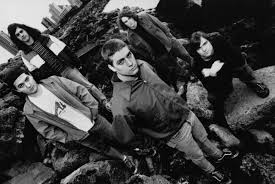
First thing: Seaweed were from Tacoma.
Not Seattle.
Tacoma.
People outside Washington tend to throw everything from around here into the same pile, but try telling somebody from Tacoma that Tacoma and Seattle are the same place and see how that goes.
Seaweed started down there in 1989: Aaron Stauffer singing, Clint Werner and Wade Neal on guitars, John Atkins on bass and Bob Bulgrien on drums. Stauffer and Werner had known each other growing up, and the whole band came out of that all-ages punk world more than anything people would later decide was "grunge." Hardcore, melodic punk, records where the guitars moved fast and the songs didn't have to choose between being loud and having a chorus.
You can hear it.
I first heard Seaweed back in Queens around '92.
Somebody at the store put on Weak and "Recall" came blasting out of the speakers.
That got my attention.
Fast guitars, big choruses, Aaron Stauffer sounding like he was trying to get every word out before the song ran away from him. Then "Baggage." "Clean Slate." "New Tools."
I bought the record.
By the time I moved out here later that year, I'd figured out that Seaweed really came from a different part of the Northwest thing than most of the bands everybody was calling grunge. They were melodic, but they weren't soft. They could write a chorus without sanding all the edges off everything around it.
And they'd already been doing things themselves before Sub Pop showed up.
John Atkins ran a little Tacoma label called Leopard Gecko. Seaweed's first record, Inside, came out on it in '89, a four-song seven-inch. Just a Smirk followed in 1990. There was also a self-titled collection of that early stuff through Tupelo and Leopard Gecko, and they did "Deertrap" for K's International Pop Underground series.
Tacoma. Olympia. Seattle.
That little stretch of I-5 explains a ridiculous amount of the records on this website.
It's also why just calling Seaweed a Seattle band misses something. They obviously became part of the larger Northwest scene, and Sub Pop eventually became their label, but Tacoma wasn't some neighborhood on the south end of Seattle. Seaweed came out of its own place and its own punk scene.
Sub Pop picked them up and Despised came out in '91, with Jack Endino recording them at Reciprocal.
Of course Jack Endino recorded them.
At this point I'm starting to think there was a law.
Despised still has one foot in those first little records. Some of the earlier material turns up again, but everything sounds more focused. Then Weak followed in '92, and that's the one that got me.
Maybe some of that is just timing. You never really get over the first record by a band that grabs you. There are records I know aren't necessarily a band's best that I'll defend forever because I remember exactly where I was when I heard them.
Weak is one of those.
But then they made Four in '93, and I probably play Four the most now.
"Kid Candy." "Losing Skin." "Card Tricks." "Chalk the Cracks."
There's something about that record where the punk part and the pop part fit together almost perfectly. It sounds bigger than the early records without sounding cleaned up, and the songs stick immediately without feeling like somebody sat Seaweed down and explained how to write singles.
They recorded the thing themselves, too, in Clint Werner's basement.
That's Seaweed in one detail.
By then the rest of the country was staring at the Northwest looking for bands, but Seaweed still sounded more like five guys who had grown up going to all-ages punk shows than anybody's idea of the next Seattle rock stars.
They toured like it, too. That was the world they fit into: punk clubs, all-ages rooms, bands like Superchunk and Quicksand, kids bouncing off each other instead of standing around waiting to see whether MTV had approved of the record yet.
Then Hollywood Records came calling.
Yes, Hollywood Records.
The Disney-owned label.
Seaweed on a Disney-owned record label.
The '90s were fucking weird.
They made Spanaway in 1995. Adam Kasper and the band produced it, and Andy Wallace mixed it, which makes more sense than the version I've heard a few times where Wallace supposedly produced the whole thing. It's a bigger-sounding record because of course it is. They were on a major now. There was more machinery around them.
They still sounded like Seaweed.
Even the title kept them close to home. Spanaway is down in Pierce County, not far from Tacoma. You can take the band out of Tacoma, apparently, but good luck getting Tacoma out of the band.
"Start With" got some alternative-radio attention, and for a minute you could imagine Seaweed becoming a much bigger band. They were even on the first Warped Tour that summer, which made a lot more sense for them than being shoved into some generic Seattle/grunge package would've.
It didn't happen.
Spanaway didn't turn them into a huge band, and there wasn't another Hollywood album.
From the outside, the whole relationship just seemed to bog down. Maybe that's the danger of signing a band like Seaweed to a major in the first place. Everybody can agree that they like the band. That doesn't mean anybody knows what the hell they're supposed to do with them once the record is sitting there.
Eventually Seaweed got out of the deal.
Bob Bulgrien left after that period too, and Alan Cage, formerly of Quicksand, ended up behind the drums.
Which is another one of those record-collection connections that makes perfect sense once you hear it.
Then Seaweed did something I really respect.
They went back to an indie.
Merge put out Actions and Indications in '99.
No big comeback campaign. No attempt to pretend the previous few years hadn't happened. Just another Seaweed record.
I liked that.
It didn't sound like five guys desperately trying to recreate Weak or figure out what alternative radio wanted in 1999. By that point the whole landscape that had surrounded Seaweed earlier in the decade had changed anyway. Sub Pop wasn't the same little operation it had been when they signed there. "Alternative" had become a marketing department. Warped Tour had become its own institution. Half the bands people associated with the Northwest explosion were gone or doing completely different things.
Seaweed just made another Seaweed record.
Unfortunately, by then they seemed pretty much worn out.
They played some shows, went down to Brazil in May, and played Merge's tenth-anniversary weekend at the Cat's Cradle in North Carolina that summer. After that, things got very quiet.
There wasn't some giant official breakup announcement that I remember. No farewell tour. No dramatic final communiqué.
That was basically the end.
At least it looks that way from here.
It's February 2002 now, and there hasn't been another Seaweed record. Aaron has already done Gardener with Van Conner from Screaming Trees, including an album for Sub Pop back in '99.
There's that fucking family tree again.
I still reach for Weak when I want the record that introduced me to them, but I think Four might actually be the best thing they did.
Ask me again next week.
What I know is that Seaweed never sounded much like Nirvana, Soundgarden or Alice in Chains to me. Putting them all together makes sense geographically, and it probably makes sense if you're trying to organize a record store, but the records tell you something else.
Seaweed sounded like kids who grew up going to punk shows in Tacoma and figured out how to write really great songs without losing the reason they started playing in the first place.
They got onto Sub Pop. They got onto a major label. They got onto Warped Tour. They got back onto an indie.
And somehow, through all of that, they still sounded like Seaweed.
From Tacoma.
And yes, I said Tacoma.