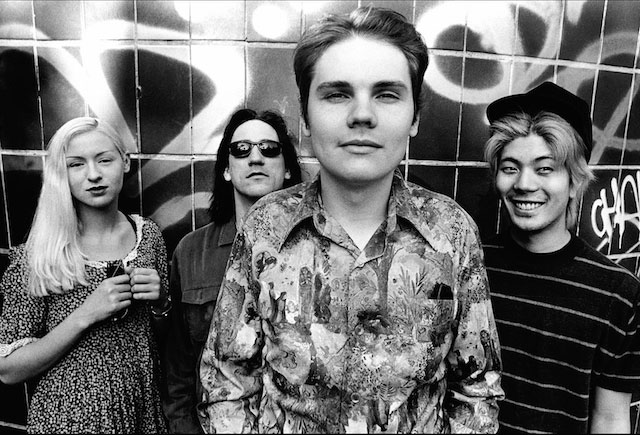
Smashing Pumpkins aren't from Seattle either.
Chicago.
There. Saved you the trouble.
I first heard them back in '91 when Gish turned up at the store in Queens. I remember the cover before I remember the music. Then somebody put it on.
“I Am One.” “Siva.” “Rhinoceros.”
Okay. Who the hell are these guys?
Billy Corgan and James Iha had this huge wall of guitars going on, but underneath all that fuzz there was something almost dreamy about it. D'arcy Wretzky held down the bass end of the band, and Jimmy Chamberlin played drums like he'd wandered into the wrong band and decided to make everybody else keep up. That was the first thing about the Pumpkins that really knocked me sideways. You had these guitars trying to swallow the room and Chamberlin underneath them playing with this ridiculous combination of power and precision. He didn't sound like some guy bashing along behind a rock band. He sounded like he could push the whole thing faster just by getting bored.
They'd been kicking around Chicago since the late '80s. Billy and James started out with a drum machine, D'arcy joined on bass, and then Jimmy came in and made the drum machine idea look pretty fucking temporary. They'd already put out “I Am One” on Limited Potential and even did “Tristessa” as a Sub Pop single before Gish, which has probably confused more than a few people over the years. No, they weren't a Sub Pop band. One record. Chicago band. Keep moving.
Butch Vig recorded Gish with them at Smart Studios in Wisconsin, and the record already had most of the things I'd end up loving about the Pumpkins: the heavy stuff, the pretty stuff, the way a song could drift around for a while and then suddenly hit you with a guitar the size of a building. “Rhinoceros” still does that to me. So does “Snail.” And Jimmy was all over the thing, playing around the guitars instead of just underneath them.
They didn't sound like Seattle to me.
Still don't.
There was psychedelic stuff in there. Sabbath. Cheap Trick. The Cure. Shoegaze. Arena rock. Probably half a dozen other things depending on which song you caught them playing. Mostly they sounded like Smashing Pumpkins, which turned out to be a much harder sound to imitate than people thought.
By the time I moved to Seattle in September '92, Gish had already become one of those records that kept hanging around. Then Siamese Dream showed up the next summer and made Gish sound almost modest.
Jesus.
That record sounded enormous.
“Cherub Rock.” “Quiet.” “Today.” “Hummer.” “Mayonaise.” “Silverfuck.”
I bought it immediately.
Vig produced that one too, and by '93 his name was permanently attached to Nevermind in everybody's head, so naturally there was another excuse for people to drag Seattle into the conversation. By then anything with enough distorted guitars could apparently get called grunge by somebody.
Fine. Whatever sells magazines.
What I remember is putting headphones on at the store and hearing all those guitar tracks stacked on top of each other. You could get lost in that record. Corgan was obsessive about those sessions and ended up playing a hell of a lot of the studio guitar and bass himself, which has since turned into this stupid shorthand where people talk like James and D'arcy barely existed. That's not how I hear the band. James was part of the guitar language, not to mention writing with Billy on things like “Soma” and “Mayonaise,” and D'arcy was the bassist standing there every night making the band work. Studio credits and being a band aren't always the same damn thing.
And Jimmy was Jimmy.
Listen to “Geek U.S.A.”
There. That's my technical explanation.
Today helped blow the doors open, with that bright melody sitting on top of something a hell of a lot darker. “Disarm” was everywhere too. “Cherub Rock” had already announced the whole gigantic guitar thing, and the deeper I went into the album, the more I liked it. “Hummer” is still one of those songs where I can forget what I'm doing halfway through. “Mayonaise” shouldn't sound as beautiful as it does with that much electricity moving around inside it.
Then, because apparently Siamese Dream wasn't enough material for Billy Corgan, they put out Pisces Iscariot in '94 and filled it with B-sides, outtakes and stray tracks that would've been some other band's best songs. “Starla.” “Obscured.” “Plume.” “Hello Kitty Kat.” Their cover of “Landslide.” James singing “Blew Away.”
That's when I started paying closer attention to the singles.
Dangerous habit.
Pumpkins singles rewarded bad behavior. You'd buy one for a song you already owned and discover something on the other side that was too good to be sitting there. Then you'd find out another version had another track. Then there were imports. Then boxes.
You know how this ends.
It ends with less money.
By '94 they were headlining Lollapalooza, which tells you how quickly the scale of the thing had changed. Gish had felt like discovering this strange Chicago band on a Caroline record. Three years later you could barely turn on MTV without seeing Billy's face.
And then came Mellon Collie and the Infinite Sadness in October '95.
A double album.
Twenty-eight songs.
Of course it was.
Nobody was ever going to accuse Billy Corgan of thinking small.
I remember opening the CD for the first time and thinking: this guy really expects me to listen to all of this.
Then I did.
A lot.
What I love about Mellon Collie is that it doesn't even pretend all twenty-eight songs should behave themselves. “Tonight, Tonight” has strings and this enormous romantic sweep to it. “Zero” sounds like somebody sharpening metal. “1979” barely seems to touch the ground. “Bodies” wants to cave your head in. “Thirty-Three” sits there quietly. “Thru the Eyes of Ruby” just keeps building. “X.Y.U.” sounds like the band got locked in a room with the tape running and decided violence was an arrangement technique.
And somehow it's all the same band.
They'd changed the way they worked, too. Flood and Alan Moulder were involved instead of Vig, and more of the band ended up in the room playing together rather than building everything quite as obsessively piece by piece. You can hear Jimmy all over it. You can hear James and D'arcy as people in a band instead of just names somebody wants to argue about in the credits. It still has Billy's fingerprints on every wall, obviously. They're very difficult fingerprints to miss.
“Tonight, Tonight.” “Zero.” “Here Is No Why.” “1979.” “Bodies.” “Thirty-Three.” “Thru the Eyes of Ruby.” “X.Y.U.”
Too much?
Probably.
That's also kind of the point.
For a while there, the Pumpkins seemed like the biggest alternative rock band in America. The videos were everywhere. The shirts were everywhere. The records were everywhere. Kids who wanted the heavy songs had the heavy songs. Kids who wanted the sad songs had the sad songs. Kids who wanted to stare at the ceiling with headphones on for nine minutes had options too.
Then everything went bad.
In July '96, touring keyboard player Jonathan Melvoin died of a drug overdose in New York. Jimmy Chamberlin was there and was arrested on a drug-possession charge. Jimmy's problems weren't exactly news to the people around the band by that point, and a few days later the Pumpkins fired him.
I remember reading about Melvoin and just feeling tired.
Not tired of the band.
Tired of another musician dying like that. Another name in the paper because drugs had stopped being somebody's private problem and turned into everybody else's headline.
Enough.
The Pumpkins postponed shows, then went back out without Jimmy. Matt Walker took over the drums for much of what remained of that touring cycle, but something had obviously changed. And musically they were changing anyway. “Eye” showed up on the Lost Highway soundtrack sounding electronic and strange, and then “The End Is the Beginning Is the End” came out of Batman & Robin with guitars and machines beating the hell out of each other.
So when Adore arrived in '98, the machines didn't exactly come from nowhere.
Still, that record didn't sound anything like Mellon Collie.
Good.
Drum machines. Real drums too. Piano. Electronics. Acoustic guitars. Little ugly bursts of electric guitar when they were needed. Songs that seemed happier to haunt a room than fill an arena.
Half the people I knew seemed to hate it.
I didn't.
Took me a while, though.
“Ava Adore” was easy. “Perfect” too. The rest of the record took some work. “To Sheila” barely seems to begin before you're already inside it. “For Martha,” written for Billy's mother after she died, isn't something I put on casually. “Blank Page” feels like the lights going out one at a time.
Now I probably play Adore more than I did when it came out.
Funny how that happens.
And for all the talk about what a disaster it supposedly was, it wasn't some record nobody bought. It went to number two and went platinum. It just came after Mellon Collie, and following a record that big is a pretty good way to make normal success look like failure.
Jimmy eventually came back in '99.
D'arcy left.
Melissa Auf der Maur came in for the road.
Those three sentences make it sound much tidier than it probably felt.
Then Machina/The Machines of God arrived in 2000, with Jimmy behind the kit again and Billy apparently determined to build another giant thing nobody could explain in one sentence.
That record is a mess.
I mean that affectionately.
There's a really good album buried in there somewhere underneath the concept, the production and whatever the hell Billy was trying to explain in interviews about Glass and machines and rock stars turning into other rock stars. I tried following it.
I really did.
Eventually I decided I liked the record more than I liked understanding the record.
“The Everlasting Gaze” sounds vicious. “Stand Inside Your Love” is gorgeous. “I of the Mourning” has Billy singing to the radio like it's the last person left awake with him. “This Time” feels like a goodbye whether that was supposed to be obvious or not. The guitars were huge again, but they weren't the same huge guitars as Siamese Dream. Everything sounded processed and crowded and metallic, like the record had been left outside in bad weather and came back pissed off.
It didn't sell like the old records.
By May, Billy had announced on the radio that the Pumpkins were going to break up after finishing what they were doing.
Then came the really weird part.
They still had another pile of songs.
Virgin wasn't going to put the material out the way the band wanted, so the Pumpkins basically said fuck it and found another way. Machina II/The Friends & Enemies of Modern Music appeared in September 2000 on Billy's Constantinople label as about twenty-five vinyl sets — a double LP plus three 10-inch EPs — sent out with the idea that people should copy the music and spread it around.
Now that I respect.
No, I don't have one of the twenty-five.
Calm down.
I have a CD-R.
So does half the planet.
Probably.
And honestly, that seems more appropriate. A record that wasn't supposed to sit behind glass as some impossible collector trophy ended up moving around as files and burned discs. Somebody ripped the vinyl, copies spread, copies of copies spread, and suddenly this album the label wasn't releasing was sitting next to the official one in people's collections anyway.
Some of the songs deserved better than being treated like leftovers, too. “Dross.” “Cash Car Star.” “Real Love.” “Home.” “Let Me Give the World to You.” There's another version of the Pumpkins hiding in that stuff, right at the moment they were disappearing.
By then everybody really did know the band was ending. Billy had already announced it.
They played their last show at the Metro in Chicago on December 2, 2000. That's the part I like. The Metro wasn't the first place Billy and James ever played under the name, but it was where Billy, James, D'arcy and Jimmy had played their first show together as the full four-piece back in October 1988.
D'arcy wasn't there for the ending. Melissa was.
Not a perfect circle.
Close enough.
Twelve years after the four-piece first played there, the band came back to the same room to finish it.
That's a pretty good way to close the book.
Except Billy apparently doesn't know how to sit still.
He's got another band going now called Zwan. Jimmy's playing with him again. Matt Sweeney is in there. David Pajo too.
Yeah.
That David Pajo.
I've heard about some of the shows they've been playing. Haven't seen them yet.
No record so far.
I'm curious.
That's all I can tell you on March 25, 2002.
Looking back, I understand why Smashing Pumpkins ended up getting thrown into the same pile as all the Seattle bands.
Same years. Same record stores. Same magazines. Some of the same people behind the boards. A lot of the same kids buying the records.
But they weren't Seattle.
They didn't need to be.
They were this huge, ambitious, fucked-up Chicago band that somehow made room for punk kids, metal kids, goth kids and kids listening to Cure records alone in their bedrooms, sometimes on the same damn album. They could be beautiful and ridiculous and brutal and sentimental and overproduced and weirdly simple. Sometimes it worked.
Sometimes it really didn't.
At least they went for it.
And I've got to admit something. For all the shit people give Billy Corgan — and God knows he makes it easy sometimes — the guy wrote a ridiculous number of great songs.
I've got the singles to prove it.